On this page the published results of this project will be displayed. These may range from presentations at (inter)national conferences to publications in scientific journals.
Conference presentations
Slimme beeldanalyses voor dementie
Improving the T1w/FLAIR ratio as a proxy for the myelin content using machine learning
Journal publications
An improved combination of T1-weighted and FLAIR contrasts for myelin water imaging
Slimme beeldanalyses voor dementie
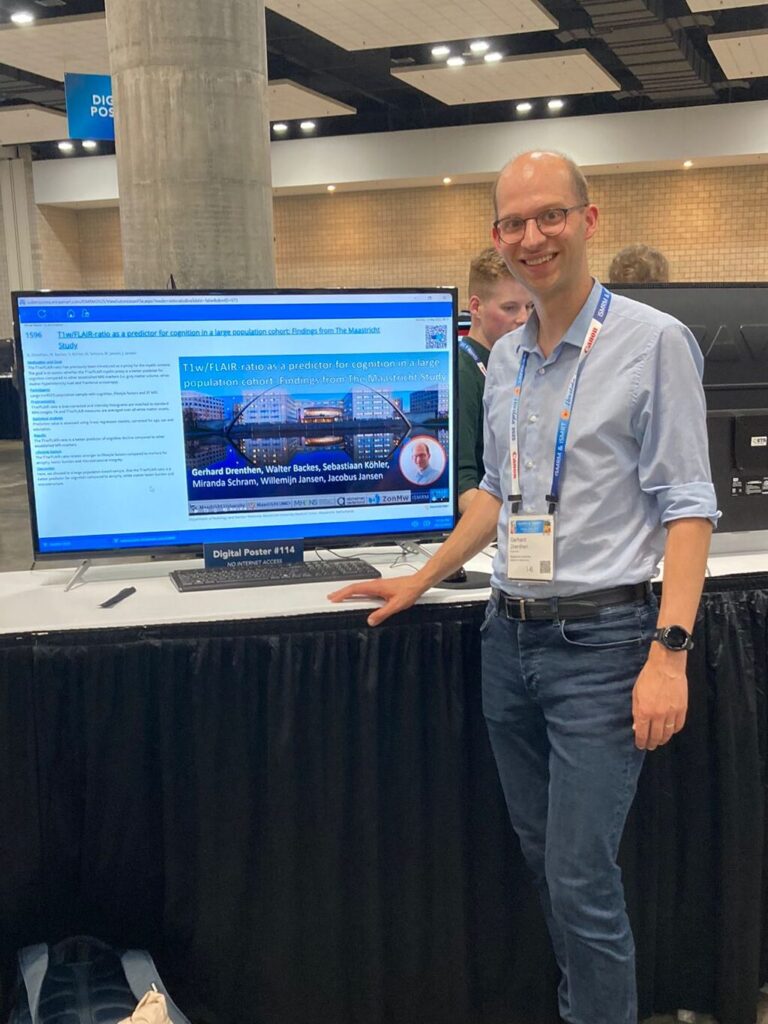
T1w/FLAIR-ratio as a predictor for cognition in a large population cohort: Findings from TheMaastricht Study
Motivation: Myelin can be a useful predictor of disease progression and cognitive decline, however it requires dedicated MRI sequences. TheT1w/FLAIR-ratio, which is more readily available, has previously been introduced as a proxy for the myelin content.
Goal(s): To assess whether the T1w/FLAIR myelin proxy is a better predictor for cognition compared to other established MRI markers (i.e. greymatter volume, white matter hyperintensity load and fractional anisotropy).
Approach: The T1w/FLAIR-ratio is calculated in a large (n=4525) population sample, and predictive value is assessed using linear regression models.
Results: The T1w/FLAIR-ratio is a better predictor of cognitive decline compared to other established MRI-markers.
Impact: The T1w/FLAIR-ratio can be used as a proxy for the myelin content. Here, we showed in a large population-based sample, that theT1w/FLAIR-ratio is a better predictor for cognition compared to atrophy, white matter lesion burden and microstructure.
Drenthen GS, Backes WH, Kohler S, Schram MT, Jansen WJ, Jansen JFA. (2025) T1w/FLAIR-ratio as a predictor for cognition in a large population cohort: Findings from The Maastricht Study, Proceedings of the ISMRM
Improving the T1w/FLAIR ratio as a proxy for the myelin content using machine learning
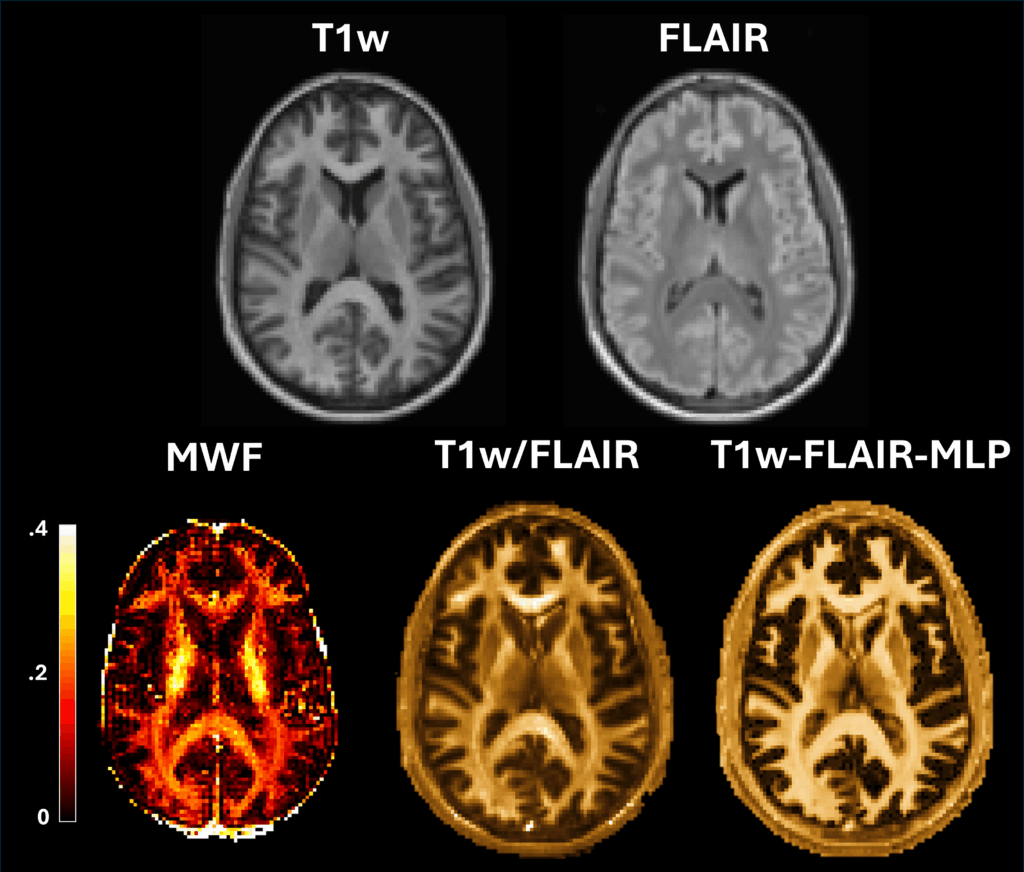
Motivation: Myelin can be a useful predictor of disease progression and cognitive decline, however it requires dedicated MRI sequences. TheT1w/FLAIR-ratio, which is more readily available, has previously been introduced as a proxy for the myelin content.
Goal(s): To assess whether the T1w/FLAIR-ratio can be improved upon using machine learning.
Approach: The T1w/FLAIR-ratio and myelin-water fraction (MWF) are calculated in a prospective (n=13) sample, and a new combination of the T1wand FLAIR ratio is calculated using a multi-layer perceptron (MLP).
Results: The T1w-FLAIR combination from the MLP has a stronger correlation with MWF values in the white matter.
Impact: The T1w/FLAIR-ratio can be used as a proxy for the myelin content. Here, we showed that a more optimal combination of T1w and FLAIRcontrasts exist, which relates to the myelin content better.
Drenthen GS, Backes WH, Lee J, Jansen JFA. (2025) Improving the T1w/FLAIR ratio as a proxy for the myelin content using machine learning, Proceedings of the ISMRM
The role of modifiable risk factors on the cerebral myelin content and cognition: findings from The Maastricht Study
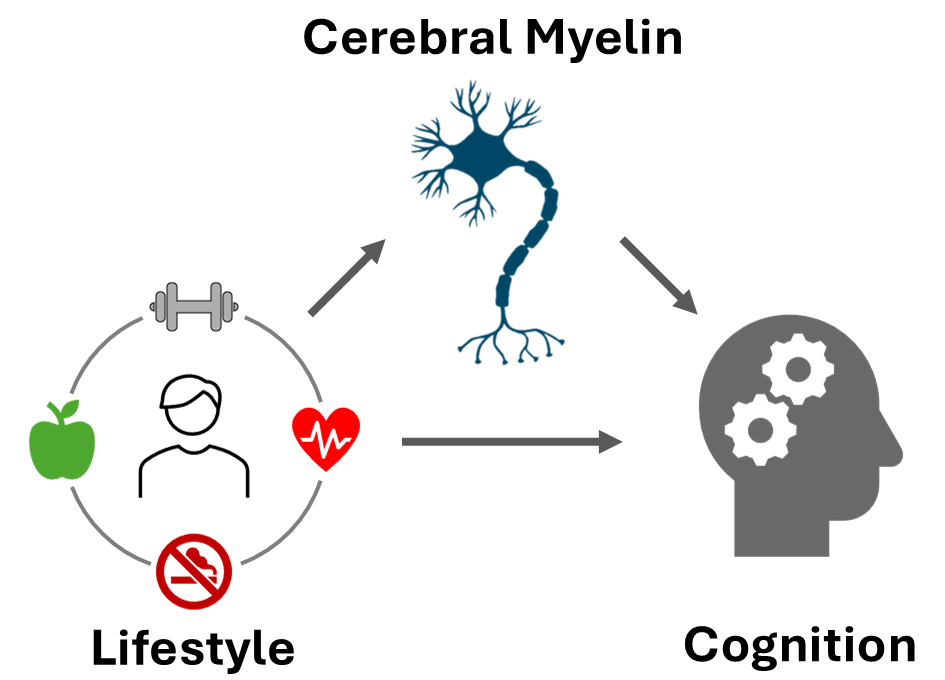
Motivation: A healthy lifestyle supports brain health, but it is still unclear how lifestyle-related risk factors contribute to cognitive decline. Myelin, the protective layer around nerve fibres, may play an important role.
Goal(s): To investigate whether lifestyle-related dementia risk factors are associated with myelin and whether myelin helps explain the relationship between lifestyle and cognitive functioning.
Approach: In 4,653 participants, a myelin measure was derived from existing T1-weighted and FLAIR MRI scans. This measure was related to the LIBRA score, which summarises modifiable dementia risk factors, and to cognitive performance.
Results: A less favourable lifestyle profile, particularly type 2 diabetes, high blood pressure and obesity, was associated with lower myelin content. Lower myelin was also associated with poorer cognitive performance. Myelin explained approximately 15% of the relationship between lifestyle and cognition, more than conventional MRI markers such as brain atrophy and white matter lesions.
Impact: The findings suggest that myelin may be an important link between lifestyle and cognitive health. Since the myelin measure can be derived from existing MRI scans, this approach could help extract additional information from standard MRI data without additional scanning time. This may be useful for studying early brain changes related to cognitive decline and Alzheimer’s disease.
Drenthen GS, Backes WH, Köhler S, Deckers K, Schram MT, Eussen SJPM, Jansen WJ, Jansen JFA. The role of modifiable risk factors on the cerebral myelin content and cognition: findings from The Maastricht Study. Geroscience. 2026 Mar 20. doi: 10.1007/s11357-026-02206-x.
An improved combination of T1-weighted and FLAIR contrasts for myelin water imaging
Motivation: Myelin is important for healthy brain function and may change with ageing and brain diseases, including Alzheimer’s disease. Measuring myelin often requires dedicated and time-consuming MRI techniques.
Goal(s): To investigate whether more information about myelin can be extracted from standard T1-weighted and FLAIR MRI scans by combining these images in an improved way.
Approach: A new mathematical method was developed using MRI data from healthy participants and then tested in an independent group, including older adults with and without small vessel disease. The method was also evaluated in a large population-based sample of 4,652 participants.
Results: The new method showed a stronger association with myelin content than the conventional T1/FLAIR ratio. In white matter, the correlation with the reference myelin measure improved by 27%. The new measure also showed stronger associations with age-related white matter changes.
Impact: The findings show that standard MRI scans may contain more information about myelin than is currently being used. This method could provide a practical way to study myelin-related changes without additional MRI scanning time, which may be valuable for large-scale studies and research into early brain changes, including those related to Alzheimer’s disease.
Drenthen GS, Backes WH, Staals J, Dinther MV, Voorter PHM, Lee J, Köhler S, Jansen WJ, Jansen JFA. An improved combination of T1-weighted and FLAIR contrasts for myelin water imaging. Neuroimage. 2026 Aug 25:122182. doi: 10.1016/j.neuroimage.2026.122182.